Blog Prompt 12:
Show an example of something you consider to be art. It can be any kind of art. Provide links or images as needed. Explain whether or not your example matches Tolstoy’s definition and whether or not you agree. If you choose to do this blog you must also present it in class.
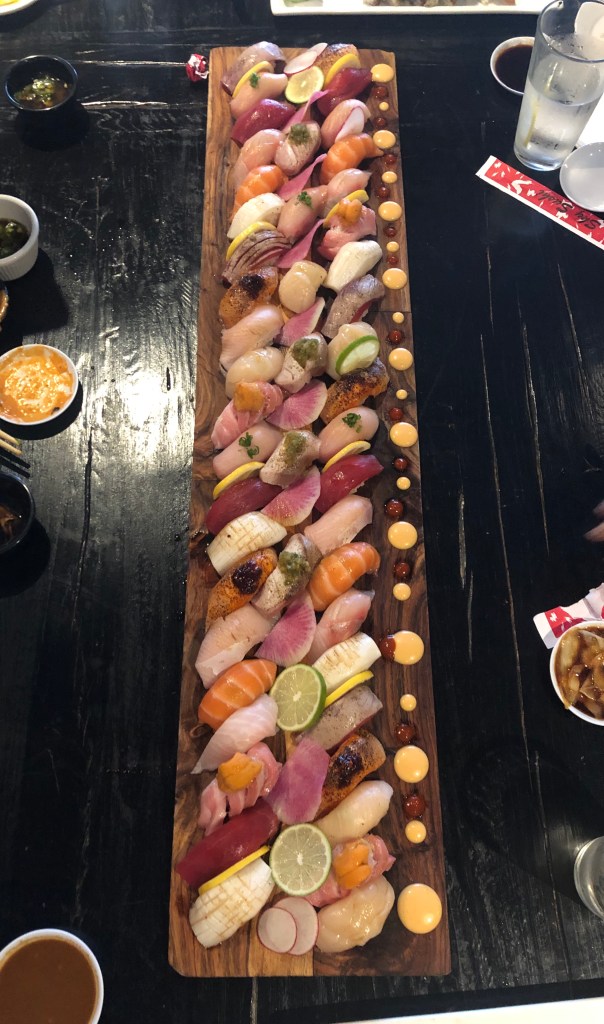
My example of art is this sushi platter. These are individual sushi pieces that art called nigiri and they are typically only made by the head sushi chef. The best nigiri are made with the freshest fish of the highest quality that are often flash frozen and are sent overnight to restaurants. This particular platter consists of a variety of fishes and seafood. More often that not, this is served with raw fish, with few exceptions of seared offerings. This platter has the following seafood offerings: tuna(maguro, chu toro, ootoro), salmon, ono, kampachi, uni, scallop, hamachi and ika. Even, though certain pieces may contain the same fish, they are all made individually as oppose to a whole roll that’s been cut into pieces. The basics of each piece is that they consist of rice, wasabi and a fish offering.
Nigiri is an art form in it’s own right. Majority of sushi restaurant’s require sushi chef to work their way up before being allowed the privileges of making nigiri. Making nigiri is seen as the final challenge of being the head sushi chef. While, these seem simple compare to a sushi roll, it is quite the opposite. With less ingredients more attention is spent on the details. Special sushi knives are required as cutting fish for nigiri is complete different. The tricky part is that each fish pose a different challenge. The sushi chef must cut the fish at specific angles and achieve specific sizes. Next, is the formation of the rice. Many experts, believe that the rice must be press once and formed in one fist like motion to achieve the prefect about of texture. Wasabi is then added to the top of the rice along with the seafood offering. Some seafood offerings are seared for an extra flavor or depth. Other seafood offerings are enhanced with sauces, but to a minimal degree as nigiri is meant for the fish flavors to be exhibited. Lastly, is the platting. As you may have noticed the nigiri’s are arranged in a systematic way. Attention to detail has not been spared when it comes to platting. Each place is strategically laid out and garish and sauce is often place around to highlight the dish as a whole.
My example matches Tolstoy’s definition of art. This may be subject to me and a select group of sushi loves, but none the less it fits into every criteria of what Tolstoy considers as art. Before I even get to the sushi restaurant, I tend to have craving and already know what I will be ordering. Nigiri, brings out a sense of excitement and satisfaction, as majority of these nigiri platters are chef special. A chef special means that the chef will decide what they of seafood will be served along with distinct preparations. This also being another level of excitement as I don’t know exactly what I will be getting. Once, the food arrives, the plating is it’s own art form and it’s definitely appealing to my eyes. Both the plating and the aroma from the dish arouse a sense of fulfillment. Each piece of nigiri beings a different experience and enjoyment. I am able to not only share this experience with the people around me, but also with the sushi chef. Their is a sense of connection between myself and the sushi chef that is achieved by the food. I could certainly vouch for this as I have been able to tell the different between the chefs. I do favor certain chef and come in certain days that I know my favor chefs will be working. I feel this is a sense of infectiousness and the degree to this infectiousness varies base off of what chef is making my nigiri.
(602 words)
 Mouakong’s Blog